ALINX AX7020, Stages 2 & 3: A Yocto Linux in QSPI Flash That Fetches Its Own Updates
Stephan BökelmannStage 1 ended with mainline U-Boot booting from QSPI flash and answering over the network, and I closed that article by saying the Linux build gets its own post. This is that post, and true to form it contains a flash chip that verified every checksum while storing everything one byte off, a bootloader that goes mute the moment you plug it into a real switch, and a real-time clock that turns out to be physically unreachable until the FPGA is configured.
This covers Stages 2 and 3 of the
bitstream pipeline plan
for the AX7020 that ALINX sent me: a self-built
Yocto Linux that boots from QSPI flash on its own, shows up on the company
network under its own hostname, accepts SSH logins only with a key, and
carries the tooling to fetch and kexec fresh development images from a
server: no PetaLinux, no vendor kernel tree, no SD card. Stage 2, the image
server, is in here too, though not in the shape the plan promised: a real
switch talked me out of netboot, and the server ended up as a plain HTTP
endpoint the running Linux pulls from; more on that below.
Same structure as last time: first the walkthrough that actually works, reproducible from the Stage 1 end state. Then every detour, because the detours are where the learning was, and at least three of them will bite anyone doing this on any Zynq board.
OF: fdt: Machine model: Alinx AX7020 board
Memory: 1008588K/1048576K available
macb e000b000.ethernet eth0: Cadence GEM rev 0x00020118
fpga_manager fpga0: Xilinx Zynq FPGA Manager registered
of-fpga-region fpga-region: FPGA Region probed
That is the end state, booted straight out of flash. Here is the way there.
The seven checkpoints
As in Stage 1, every step ends in something you can test, because the expensive failures on this road are the ones that pass every check you did think of. The walkthrough is built around seven checkpoints:
| # | After | What must be true |
|---|---|---|
| 1 | Yocto build | 3953 tasks succeed; the FIT exists, dumpimage -l lists kernel, DTB and initramfs with SHA256 hashes |
| 2 | RAM boot | tftpboot + bootm boots Linux; /sys/class/fpga_manager/fpga0/ exists; port 22 answers (ping does not count) |
| 3 | board identity | DHCP log shows a lease for the fixed MAC 02:41:58:70:20:01 with hostname ax7020, surviving an environment wipe |
| 4 | flashing the FIT | read-back MD5 matches, and the first words at several different flash offsets differ from each other (see detour 7) |
| 5 | standalone boot | power cycle with J13 on QSPI: Linux up, SSH reachable, no JTAG, no TFTP |
| 6 | company network | the board appears in the DHCP inventory API by name; SSH works through the office switch |
| 7 | key-only SSH | login with the deployed key succeeds; wrong key, no key and password login are all rejected |
If a checkpoint fails, everything before it is known-good. All self-written files (the Yocto layer, the U-Boot patches, the host tools) live in github.com/MaxClerkwell/ax7020-bringup. Now the walkthrough.
The starting point
The board is where Stage 1 left it: boot.bin (mainline SPL) and
u-boot.img in QSPI, operated entirely over U-Boot’s netconsole on UDP port
6666, no serial cable. The lab tools are the same two Python scripts from the
repo: tools/ncsh.py for the netconsole and tools/tftpd.py as an
unprivileged TFTP server.
Goal of this session: Linux.
Step 1: A Yocto build for a board Yocto has never heard of
Picking the release
scarthgap (Yocto 5.0 LTS), and not out of preference:
git ls-remote --heads https://github.com/Xilinx/meta-xilinx | grep -E "scarthgap|styhead|walnascar"
# -> only scarthgap
meta-xilinx offers no newer release branch, and that pins the common
denominator for everything else: poky, meta-arm and meta-openembedded all get
checked out on scarthgap, as shallow clones, about 170 MB total.
One host-side wrinkle before the first bitbake: Debian 13 no longer ships
liblz4-tool, the binary lives in the lz4 package, and Yocto wants it
under the old name lz4c, which lz4 ≥ 1.10 no longer installs. Instead of a
root-owned symlink in /usr/local/bin, the symlink lives in the repo
(yocto/hostbin/lz4c → /usr/bin/lz4) and setup-build.sh prepends
hostbin to PATH. No root, and the fix travels with the repository.
The layer
yocto/meta-ax7020/ holds everything board-specific. The machine
configuration builds on meta-xilinx’s generic Zynq machine and narrows it
down:
require conf/machine/zynq-generic.conf

KERNEL_DEVICETREE = "xilinx/zynq-ax7020.dtb"

KERNEL_IMAGETYPE = "fitImage"
KERNEL_CLASSES   = "kernel-fitimage"
INITRAMFS_IMAGE  = "ax7020-initramfs"
INITRAMFS_IMAGE_BUNDLE = "0"

# U-Boot comes from mainline, not from Yocto
PREFERRED_PROVIDER_virtual/bootloader = ""
The kernel device tree is a sibling of the U-Boot one from Stage 1: every
value traced back to the ALINX design_1.hwh and the schematic, none of it
copied from a template. The load-bearing nodes:
&gem0 {
status = "okay";
phy-mode = "rgmii-id";
phy-handle = <ðernet_phy>;
ethernet_phy: ethernet-phy@1 { reg = <1>; }; /* RTL8211E-VL */
};
&qspi {
status = "okay";
num-cs = <1>;
flash@0 {
compatible = "w25q256", "jedec,spi-nor";
spi-rx-bus-width = <1>;
spi-max-frequency = <25000000>;
};
};
A kernel config fragment switches on what the project needs (the FPGA
manager framework, device-tree overlays, SPI-NOR, netconsole) and throws out
what the board does not have (DRM, sound, WLAN, IPv6). The pleasant surprise:
zynq-7000.dtsi already ships devcfg@f8007000 and an fpga-region node
enabled, so the FPGA manager, the one feature this Linux absolutely must have
for the later stages, needed nothing board-specific at all.
The image recipe is core-image-minimal as a cpio.gz initramfs, plus
dropbear for SSH.
Building
source yocto/setup-build.sh
bitbake virtual/kernel
One operational rule that cost an hour before it was a rule: start bitbake
detached. If the client terminal goes away, it takes the bitbake-server
with it (“Exiting as we could obtain the lock”) and the build stalls:
setsid nohup bash -c 'source yocto/setup-build.sh >/dev/null 2>&1; \
    exec bitbake virtual/kernel' > build.log 2>&1 < /dev/null &
Restarts are cheap: sstate-cache and tmp/work let it resume where it
died. The build hit three genuine errors on the way through (detours 1–3
below); with those fixed, 3953 tasks completed overnight.
Checkpoint 1: verify the artefacts on the host.
| Component | Size |
|---|---|
| Kernel (linux-xlnx 6.6.40) | 3.79 MiB |
| Device tree | 11,651 B |
initramfs cpio.gz |
4.27 MiB |
| FIT total | 8.06 MiB |
dumpimage -l fitImage must list all three sub-images with their SHA256
hashes. Nothing downstream can work if this fails, and unlike everything
downstream, this failure comes with an error message.
Step 2: First boot, from RAM only
Deliberately without touching the flash: a failure here costs nothing.
tftpboot 0x2000000 fitImage
setenv bootargs 'console=ttyPS0,115200 ip=dhcp'
bootm 0x2000000
U-Boot verified all three sub-images against their SHA256 hashes and handed over. Linux came up, took a DHCP lease, and dropbear answered.
Checkpoint 2: Linux is provably running. Two parts. First,
/sys/class/fpga_manager/fpga0/ must exist, with the attributes name,
state, status and firmware; the last one is the file-write interface
Stage 4 will use to load bitstreams. Second, port 22 must answer. Not
ping: U-Boot happily answers ICMP while sitting in its netconsole loop, so a
successful ping proves nothing about which of the two systems you are
talking to. The reliable liveness test for Linux is the SSH port.
(A netconsole= kernel parameter, the obvious way to keep the cable-free
console into Linux, stayed silent; that is detour 4.)
Step 3: A fixed identity in U-Boot
Until now the board drew a random MAC on every boot
(CONFIG_NET_RANDOM_ETHADDR) and sent no hostname, which makes “find the
board on a network with 40 other devices” a daily annoyance. Two changes,
both baked into the U-Boot binary so they survive a wiped environment:
CONFIG_BOOTP_SEND_HOSTNAME=y
#define CFG_EXTRA_ENV_SETTINGS	\
	"ethaddr=02:41:58:70:20:01\0"	\
	"hostname=ax7020\0"		\
	...
The MAC is locally administered (02:), 41:58 is “AX” in ASCII, 70:20
the board number. Silly, memorable, and it can never collide with a vendor
OUI.
While rebuilding U-Boot anyway, a twelve-line patch went in for shared-lab
politeness: as long as ncip is the broadcast address, the first host that
types into the netconsole claims it; U-Boot sets ncip to that caller’s
address, and everyone else’s input is ignored. The claim lives only in the
RAM environment, so a reboot releases the board, and the owner can release
it early with setenv ncip 255.255.255.255. To be clear about what this is:
convenience, not security. The netconsole has no authentication; whoever
wins the race owns a bootloader prompt with sf write on it.
Checkpoint 3: the identity sticks. The DHCP server’s log must show the lease bound to the fixed MAC and carrying the name:
DHCPACK on 10.42.100.134 to 02:41:58:70:20:01 (ax7020) via eno4
Step 4: The architecture decision the switch forced
The original plan for this stage was pure netboot: U-Boot fetches the FIT over TFTP on every power-up, nothing but the bootloader in flash. On the lab network, board and workstation joined by one USB Ethernet adapter, that worked flawlessly. On the company switch it died in a way that took a packet capture to understand (detour 6 has the full autopsy): U-Boot re-initialises the Ethernet link on every netconsole poll, the switch port restarts its spanning-tree timers on every link bounce, and the two livelock each other forever. Two seconds of boot messages, then permanent silence.
The conclusion is worth stating as a design rule: a bootloader is not a network citizen. U-Boot’s network stack is a polling loop bolted to a console; it was never meant to hold a link on managed infrastructure. Linux brings the interface up once and handles link changes like an adult.
So the architecture flipped into what it should have been from the start: a small, boring maintenance system resident in flash, and development images that never get written to flash at all.
Flash (rarely changes)              Network (changes daily)
├─ SPL + U-Boot
└─ FIT: kernel + initramfs      ──►  Yocto image from HTTP/Nextcloud
   with curl, CA certificates,              │
   kexec, ntpd, dropbear                    │
        └── fetch, verify, kexec ───────────┘
The flash-resident image gained an updater package and CONFIG_KEXEC=y in
the kernel. The updater is a short shell script: fetch the image with curl,
check the first four bytes are the FIT magic d00dfeed (this catches error
pages and captive portals before they reach the kernel), then
kexec -l and kexec -e straight into the new system. No reboot, no flash
write, no jumper.
This is also where Stage 2 of the original plan quietly dissolved: the “image server” is no longer special boot infrastructure the board depends on, just any HTTP endpoint the updater can reach. Fetching over HTTPS surfaced one genuinely obscure board fact about the RTC, which is detour 8.
The new flash layout
The Stage 1 layout reserved 13 MiB for a 1 MiB U-Boot; that got tightened, and the FIT gets the rest of the chip:
| Offset | Content | Slot |
|---|---|---|
0x000000 |
boot.bin |
1 MiB |
0x100000 |
u-boot.img |
2 MiB |
0x300000 |
environment + redundant copy | 256 KiB |
0x340000 |
FIT | 28.75 MiB |
bootcmd went into the binary rather than the environment:
CONFIG_BOOTCOMMAND="sf probe 0 30000000 0; sf read 0x2000000 0x340000 0x1000000; bootm 0x2000000"
Two reasons, both learned the hard way: saveenv simply does not work in
JTAG boot mode (U-Boot reports ENVL_NOWHERE there), and long setenv
commands break over the netconsole, where a swallowed quote character leaves
the parser waiting for a continuation line and eating everything that
follows. The read covers 16 MiB rather than the exact image size so a
growing maintenance system fits later without a U-Boot rebuild.
Step 5: Flash it, and read back more than one offset
The flashing itself is the Stage 1 recipe: TFTP the FIT into DDR, sf
erase, sf write, read back, compare MD5. It passed. And the board did not
boot, because of the single nastiest failure of this whole project, the BAR
address-mode bug of detour 7, whose defining property is that write and
read-back were self-consistent and both wrong. Every MD5 check passed
while every byte sat one position off in the physical array.
Checkpoint 4 therefore has two parts, and the second exists purely
because of that detour: the read-back MD5 of the flashed region must match
the host, and reading the first words at 0, 0x100000 and 0x340000
must return different data at each offset. If several distant offsets read
identically, the flash addressing is broken, not the content, and no
checksum will ever tell you.
Checkpoint 5: the board boots Linux entirely on its own. JTAG cable
off, J13 on QSPI, power cycle. The chain is now BootROM → SPL → U-Boot →
FIT from flash → Linux, and the test is the same as checkpoint 2: a lease
for ax7020 within seconds, and port 22 answering. On the company switch
this now works, because by the time spanning tree releases the port, the
one who retries is the Linux kernel, not a bootloader in a polling loop.
Sidebar: finding the board again, and a DHCP inventory API
With the board destined for the company network, “which IP does it have today” needed a real answer. That turned into a small service of its own: a REST API that reports every device the DHCP server knows about as JSON, reading the server’s state (config reservations plus live leases) instead of scanning the subnet, so it also finds devices that are currently off. It is public and generic at github.com/MaxClerkwell/dhcp-inventory-api.
curl -s http://10.42.0.1:8000/get_all_network_clients | jq
Deploying it in a container on the actual router surfaced three details that are anything but cosmetic, and each failed silently:
--network hostis mandatory./proc/net/arpis per network namespace. A bind-mount of the file shows the container’s three neighbours, not the router’s 38, and the endpoint keeps answering cheerfully, just nearly empty.- Mount directories, not files. ISC dhcpd rewrites its lease database
via a temp file plus
rename. A bind-mount of the file pins the old inode, and the container serves a snapshot frozen at container start. This was only noticed because the freshly connected AX7020 had a lease and did not appear in the list. - Pin the listener address. With host networking the port would
otherwise be open on every interface of the router, including the
uplinks.
ss -lntpmust show exactly one bound address.
There was also a ghost device named fantasia: Debian’s commented-out
example block in dhcpd.conf, faithfully parsed. The parser now strips
comments and only accepts a fixed-address that parses as an address.
Checkpoint 6: the board is discoverable. The API must list ax7020
with its fixed MAC and current address, and SSH must work through the
office switch.
Step 6: Updating the flash without JTAG
Once Linux runs, the jumper dance is over for good. The MTD partitions from
the device tree are visible, and /dev/mtdblockN handles erasure itself:
# file onto the board: scp fails for lack of an sftp-server in the minimal image
ssh root@ax7020 'cat > /tmp/fitImage' < tftp/fitImage

# write and verify
ssh root@ax7020 '
  dd if=/tmp/fitImage of=/dev/mtdblock3 bs=64k conv=fsync
  sync
  dd if=/dev/mtdblock3 bs=1 count=<size> 2>/dev/null | md5sum'
About ten minutes at QSPI pace, then reboot. The maintenance system
updates itself over SSH; JTAG is now strictly a rescue tool.
Step 7: SSH with keys only
A passwordless root login is fine on a point-to-point lab cable and
indefensible on a shared network. Two small recipes fix it: one installs
authorized_keys for root, one configures dropbear with -s (disable
password authentication).
One warning that will lock somebody out: poky’s shipped dropbear.default
sets -w, which forbids root logins entirely, keys included; until now
only the debug-tweaks image feature was overriding that. Remove
debug-tweaks (as you must, it is what makes root passwordless) and leave
the rest as-is, and you have locked yourself out of the board. The correct
configuration is -s alone, with * in root’s password field.
Checkpoint 7, verified on the running board:
| Test | Result |
|---|---|
| login with the deployed key | ✅ |
| login with a different key | ❌ rejected |
| login without a key | ❌ Permission denied (publickey) |
| login with a password | ❌ Permission denied (publickey) |
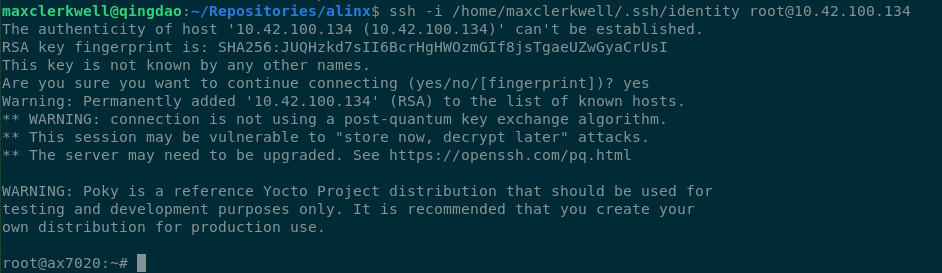
Stage 3 complete. BootROM, SPL, U-Boot, FIT, Linux: everything from flash,
on the company network, reachable only with the right key, with a tested
path to update itself over SSH and a built (though not yet fired) kexec
path for development images.
The nine detours
Same rule as last time: the walkthrough above reads like a tidy evening, and it was not. Chronologically, because several only make sense in sequence.
1. ${UNPACKDIR} does not exist in scarthgap
| install: cannot stat '/zynq-ax7020.dts': No such file or directory
ERROR: linux-xlnx do_configure failed
The variable arrived with Yocto 5.1; in scarthgap, SRC_URI files land in
${WORKDIR}. Copy a do_configure snippet from current documentation into
an LTS build and the path expands to nothing, and the error message shows
the result of the empty expansion, not the variable that caused it.
Fix, as it ended up: the bbappend probes both locations:
src="${UNPACKDIR}/zynq-ax7020.dts"
[ -f "$src" ] || src="${WORKDIR}/zynq-ax7020.dts"
2. bootgen-native will not build with GCC 15
utils/src/cdo-load.c:140:14: error: assignment to 'char *' from incompatible
pointer type 'uint32_t *' [-Wincompatible-pointer-types]
Since GCC 14 this is an error, not a warning. The irony: this build does not
need bootgen at all, boot.bin comes from the mainline SPL, but meta-xilinx
pulls it into the dependency chain regardless.
Fix, as it ended up: a bbappend that defuses exactly this diagnostic
with -Wno-incompatible-pointer-types. Not pretty, but it patches a tool
whose output is thrown away.
3. An initramfs recipe needs an empty IMAGE_NAME_SUFFIX
ERROR: Could not find a valid initramfs type for ax7020-initramfs-ax7020,
the supported types are: cpio.lz4 cpio.lzo ... cpio.gz ...
scarthgap appends .rootfs to image names; kernel-fitimage looks for the
name without it. The supported types listed in the error are a red herring:
the type was fine, the filename was not.
Fix, as it ended up: IMAGE_NAME_SUFFIX ?= "" in the image recipe, the
same line poky’s own initramfs recipes carry for exactly this reason.
4. netconsole= as a kernel parameter stays silent
The obvious way to keep the cable-free console into Linux,
netconsole=6666@/eth0,6666@192.168.77.1/, produced nothing. That early in
boot, the module cannot do ARP resolution; without the target MAC spelled
out in the parameter, it sends to nobody, and it does so without a single
complaint in dmesg that would point at the cause.
Fix, as it ended up: accepted rather than fought. Linux gets a real console over SSH minutes later anyway; the netconsole matters for U-Boot, where it stays. Filed under “the boot parameter needs the full MAC syntax if it is ever needed.”
5. Ping proves the wrong thing
During the first RAM boots, “the board answers ping” repeatedly stood in for “Linux is up”, and it repeatedly lied: U-Boot answers ICMP too, from its netconsole loop, with the same IP the kernel would have. When a boot hung, ping kept succeeding and the diagnosis ran in circles.
Fix, as it ended up: a procedural rule that made it into the checkpoints: liveness for Linux is port 22, never ICMP. Checkpoints 2 and 5 both encode it.
6. The spanning-tree livelock: U-Boot goes mute on a real switch
The one that changed the architecture. On the company switch, the DHCP
handshake completed cleanly, two seconds of netconsole output arrived, then
nothing: no ARP, no ping, no console. Ever. The router had no tcpdump, so
a raw AF_PACKET capture in Python had to stand in, and it showed the
board sending its last packet at 15:14:01 and then falling silent.
The cause sits in plain sight in the source. Every netconsole poll calls
net_loop(), which re-initialises the Ethernet device; zynq_gem_init()
calls phy_startup(), which fails while the link is down. U-Boot even has
a provision to skip re-init when the last protocol was netconsole, but
after dhcp the last protocol is BOOTP, so the very first console poll
needs a full init. On a managed switch that init tears the link down while
the port is still in spanning-tree listening state, the switch restarts its
timers on the new link, and the two sides livelock: the port never
forwards, U-Boot never gets a link. On the lab’s directly attached USB
adapter this can never happen, because autonegotiation there completes in
milliseconds with nobody holding the port back.
Fix, as it ended up: not a patch, a design change. A bootloader is not a network citizen; the thing that lives on the network must be Linux. That single realisation produced the flash-resident maintenance system of Step 4, which is a better architecture anyway.
7. The BAR disaster: every checksum passes, every byte is wrong
After flashing the FIT, the BootROM parked at 0xffffff28 with the boot
mode correctly reading QSPI, exactly as if the flash were empty, although
all three regions had verified by MD5 immediately after writing. On the
next JTAG boot, offset 0 contained text data and 0x340000 zeros. A full
erase read back 0xFF everywhere, so the chip was healthy.
The tell came from comparing several offsets:
sf read ... 0        -> fffffe00 fffffeea fffffeea
sf read ... 0x100000 -> fffffe00 fffffeea fffffeea      identical!
sf read ... 0x340000 -> fffffe00 fffffeea fffffeea      identical!
The same data at every address, shifted by one byte, and eafffffe is the
start of boot.bin. Cause: CONFIG_SPI_FLASH_BAR. The 32 MiB W25Q256 runs
in 4-byte address mode; with BAR enabled, U-Boot sends only three address
bytes, the chip consumes the dummy byte as the fourth address byte, the
address overflows and lands near zero, and all data arrives one byte
shifted. The vicious part: writes and reads went through the same broken
addressing, so they were mutually consistent. Every verification passed,
patiently confirming a wrong thing, while the BootROM, which correctly
speaks three-byte addressing on its own, found nothing where boot.bin
was supposed to be.
Fix, as it ended up: ./scripts/config --disable SPI_FLASH_BAR,
rebuild; spi-nor then uses native 4-byte opcodes, and the same flash
procedure immediately produced a booting board. Plus the second half of
checkpoint 4: always read back several distant offsets and require them
to differ. That check costs seconds and is the only one in this list that
catches an addressing bug, because checksums by construction cannot.
8. The RTC is unreachable without a bitstream
The updater fetches images over HTTPS, and curl rejected every
certificate as “not yet valid”: the clock stood at the epoch. Setting the
time with NTP would be routine, except for why there was no hardware clock
in the first place:
grep -o 'PCW_I2C[01]_I2C[01]_IO" VALUE="[^"]*"' design_1.hwh
# PCW_I2C0_I2C0_IO" VALUE="EMIO"
# PCW_I2C1_I2C1_IO" VALUE="EMIO"
Both I²C controllers are routed through EMIO, i.e. through the FPGA fabric. Without a loaded bitstream there is physically no path from the processor to the RTC. A dependency loop hides here: the pipeline exists to load bitstreams over HTTPS, HTTPS needs the time, and the clock sits behind a loaded bitstream.
Fix, as it ended up: the updater runs ntpd -n -q against a
configurable server before any HTTPS fetch, and dies with a clear message
if the clock cannot be set. Busybox ships the ntpd applet disabled; a
one-line config fragment enables it. The board simply has no usable RTC
until a bitstream provides the I²C route, and now the scripts know that.
9. Dropbear’s -w locks out root completely
Hardening SSH nearly bricked the access instead: poky’s default dropbear
arguments include -w, which rejects all root logins, key or not. The
only reason key logins had worked before was the debug-tweaks image
feature quietly overriding it. Removing debug-tweaks, which is mandatory
for anything leaving the lab since it is also what makes root passwordless,
would have left -w in force and the board unreachable, on a system whose
only console is SSH.
Fix, as it ended up: an own dropbear.default with -s alone
(password authentication off, key logins allowed), root’s password field
set to *, and the four-row login test matrix of checkpoint 7 run before
the old image was overwritten. On a box with no serial console, test the
new lock before discarding the old key.
Closing
The score this time: three build errors, one architecture change forced by a switch, and one flash bug that defeated every checksum thrown at it. The recurring shape is the same as in Stage 1, but sharpened: the worst failures were not the loud ones, they were the ones where every verification passed. The BAR bug confirmed a physically shifted flash image with an unbroken chain of matching MD5s; the container served a frozen lease file and an incomplete ARP table without a single error; ping cheerfully vouched for a Linux that was not running. Verification can patiently confirm a wrong thing, and the countermeasure is always the same: test the property you actually need (different data at different offsets, port 22, the inode inside the container) rather than a proxy for it.
Everything is in github.com/MaxClerkwell/ax7020-bringup: the Yocto layer, the U-Boot identity and console-claim patches, the updater recipes, the dropbear configuration, and this walkthrough in longer form. The DHCP inventory API lives in its own repository, dhcp-inventory-api.
Next is Stage 4: a bitstream from the open toolchain, Yosys and
nextpnr-xilinx, written into /sys/class/fpga_manager/fpga0/firmware over
SSH. The FPGA manager is registered and waiting, the board is one curl
away, and somewhere behind an EMIO pin there is a real-time clock that
would very much like a bitstream to finally exist. That build now has its
own article:
an open bitstream over REST, and the one missing line that hangs both cores.