KiCon Europe 2026: Trip Report without the Trip
Stephan BökelmannIn April 2019 I flew to Chicago for the very first KiCon and wrote a brief trip report on the way home. It ended with the sentence “It almost looks like we will be organizing some sort of event like this in Germany.” Seven years later I no longer have a trip to report on. The conference comes to me. From 7 to 9 September 2026 KiCon Europe took place at Gleis 9 in Bochum, organised by KiCad Services Corporation together with Open Skunkforce e.V., which in practice means Seth Hillbrand and me.

What KiCad is, for the people who landed here by accident
KiCad is a free and open source suite for electronic design automation. You draw a schematic, assign footprints, lay out the printed circuit board, run design rule checks, simulate with SPICE, and export the manufacturing data. It started as a one-person project by Jean-Pierre Charras in 1992, was picked up by CERN around 2013 when they needed a tool they could audit and extend for open hardware, and has since grown into a professional-grade package with a full-time developer team. The Zynq deployment concept, the OmnAIScope and every board I have shown on this blog were drawn in it. The project is funded by donations and by commercial support through KiCad Services Corporation, and KiCon is the place where the developers and the users meet in person.
How we got here
This was the third KiCon Europe in Bochum, after 2024 and 2025. Before that I had already run KiCon Bochum in 2021, 2022 and 2023, without any institutional backing from the KiCad project. Those were community events in the most literal sense: a room, a projector, whoever showed up. The idea for all of it came from Chicago 2019, when Chris Gammell invited me to the first KiCon at mHub. Since 2024 the project itself has been the co-organiser, which changes a lot about the budget and nothing about the atmosphere.
On our side, every one of these events runs through Open Skunkforce e.V., the non-profit association we founded in Bochum for exactly this purpose. It is the legal entity behind KiCon Bochum, KiCon Europe, emBO++ and the Practical Data Science Conference: it signs the venue contract, holds the storage room with the crates, and makes sure the tickets cover the costs rather than a profit margin. No sponsor money goes anywhere except into the next event.
If you want the earlier chapters, they are all on this blog: KiCon 2019 in Chicago, KiCon Europe 2024, the first edition with the project on board, and KiCon Asia 2025 in Shenzhen, where I was on the other side of the lectern for once. Why I keep doing this at all is in Ten Years of Conferences.
This year: two days of conference and one day of training. Programme from nine in the morning until six in the evening on all three days, then a wind down and a cold beer.
Day one
Day one is always the stressful one for an organiser. Be there early. Attendees show up much earlier than the schedule suggests. The coffee has to be ready before the first one walks in, not after. Name badges, power strips, the projector adapter that someone always needs. This year, thanks to Hasan from Gleis 9 and his team, everything ran on rails. It was the most relaxed conference I have ever run, and I have been doing this since 2014.

Once everybody had found the breakfast buffet, Seth gave a short welcome talk, and then Wayne Stambaugh, KiCad’s lead developer, went straight into the hard stuff: the feature set for KiCad 11. My two highlights were the visual overlay for skew matching, which shows you on the board where a differential pair or a bus is out of tolerance instead of burying it in a DRC list, and the improvements to the IPC API. I still wonder why it has to be protobuf over NNG rather than a plain REST or WebSocket server. A network-facing interface would make it much easier to write plugins in whatever language, or to build entirely different user front-ends on top of the same core. But fine. The IPC as it is today is good enough for the plugins I want to write.
Next up was prod-to-go by Magnus Axelsson and Simon Lindh from Elektronikutvecklingsbyrån (EUB) in Sweden. They built their own toolchain that takes a KiCad board and generates the test and flashing rig for it semi-automatically: cradle, pogo pin positions, plungers, camera mount. Everything open source. If you have ever spent a week building a bed of nails for a board that changed the next week, this is the talk for you. There is a video of the workflow on YouTube.

After that, Raphael Specht, field application engineer at Würth Elektronik, gave a short demo of his 3D workflow between KiCad and FreeCAD. I always find it worthwhile to watch how other people actually use their tools. You pick up a shortcut or a habit every time.

After a long lunch break in the courtyard, Prof. Holger Vogt presented the latest ngspice, the simulation engine behind KiCad’s simulator. I have played with ngspice on and off for years but never used it seriously in production. Maybe I should. The feature in version 47 that got me is black-box models from S-parameter files: characterise a real device under test with a VNA, drop the Touchstone file into the simulation, done. What impresses me even more is Holger himself. He has long since retired and could sit back. Instead he keeps maintaining one of the most important open source simulators there is, and shows up in Bochum to talk about it. An icon of the open source community, in my book.

Then KiCAD-Prism. Krishna Swaroop Dhulipalla and Matteo Parenti have built a complete, self-hosted project management platform for KiCad teams: git-native, online board and schematic viewer, design reviews, parts library governance. Wild what the two of them have put together.
After the coffee break, Kuan-Chung Chiu presented Kikakuka, his workspace tool. Panelisation is one of the things he has genuinely solved with it. The other is live bidirectional sync with FreeCAD: change the edge cut in KiCad and the board re-renders in FreeCAD; move a connector on the board in FreeCAD and the footprint position updates in KiCad. That second direction is the one mechanical engineers have been asking for.
Marco Straubel then showed how he uses KiCad at DLR to build the rigid-flex harnesses for their deployable carbon fibre booms, the kind that unroll in orbit. Export from CATIA, refinement in KiCad, and the result has flown. I never stop being amazed by how much outrageous hardware is designed in KiCad. I am looking forward to visiting Marco in the coming days.
Same theme right after: Manuel Gonzalez works on astroparticle and neutrino experiments at APC in Paris and wanted to predict and optimise flex PCB shapes for space electronics. He succeeded, is the short version.
Tom Elliot closed the day with a genuinely neat AI agent for KiCad work. His framing, that AI PCB tools keep trying to automate the fun part while the boring half stays manual, was the right one.
The evening wound down at Gleis 9 while Swaroop and the EUB team gave live demos of their projects.
Day two
Day two started with Petr Hodina and an open hardware USB/IP bridge. The problem he is solving is a nice one: in a hardware CI lab you used to drop a cheap Linux SoC next to every device under test, and the DRAM shortage killed that. His answer is a board around a RISC-V microcontroller that runs entirely from on-chip memory, no DDR at all, but still carries USB 3.0, Gigabit Ethernet and a secure element so the lab can verify each bridge is genuine before trusting it. Three demanding subsystems on one small board, all routed in KiCad. His day job is mobile Linux, and listening to him I decided I should finally put mobile Linux on my own phone.
Dominik Wernberger then walked through the reverse-engineering journey behind OpenOrCadParser, starting from scratch in 2021. Discovering that OrCAD’s DSN and OLB files are Microsoft Compound File Binary containers, pulling out the individual streams, getting the alignment right with a hex editor, and then decoding what each byte actually means. An enormous amount of work, and fascinating to watch it laid out step by step. I did catch myself wondering how important this kind of task will be in a few years, since large language models are getting rather good at exactly this sort of pattern hunting. Or are they? I am honestly not sure.
Tjark Gaudich talked about product lifecycle management in KiCad, driven by ISO 22163, which demands PLM down to the component level. His approach is a custom editor for KiCad database libraries so the workflow plugs into the existing archival and ordering process without a separate PLM suite. That much I got from the abstract. I had to step out for some fresh air during his slot, so I honestly cannot tell you more. The recording will.
Peter Kämmerling from JCNS instrument technology at Forschungszentrum Jülich asked whether scientific electronics development in Germany is transitioning to KiCad. He introduced SEI, the conference of the scientific instrumentation study group, and pitched to its members that they should contribute to KiCad and its libraries rather than just consume them. It is good to see, again, that the German physics community keeps moving to KiCad. In the evening Peter and I had a long conversation about neutron experiments, in particular how you guide a neutron beam from the source to the instrument. Genuinely exciting. I have been to Jülich often enough myself, back when COSY was still running and we tested HV-MAPS there.
cpresser shared his workshop concept for teaching KiCad to beginners. He estimates somewhere between 500 and 1000 people have gone through one of his workshops by now, and the whole thing fits on a single printed page: an astable multivibrator from schematic to Gerber, with the keyboard shortcuts inline. It sounded a lot like my own workshops, so I am reassured for now.

After lunch, Viktor Váczi presented PCBJam, KiCad in the browser, with Figma-style collaboration on top: other people’s cursors and selections, comments, shared libraries. I don’t know. Maybe in a few years. So far I have not worked out what it is for. The access problem in concurrent editing of a layout is not trivial at all, meaning who is allowed to change what, and when, and how you keep two people from routing through the same via. And interactive routing needs serious compute if you want complex DRC evaluated live while you drag a trace. Interesting to see where it goes, but for my daily work it does not solve a problem I have yet.
Update, 13 September: Viktor sent me the link to the public demo at demo.pcbjam.com, and the real launch is scheduled for next week. Having clicked through it, I stand by the above for my own boards: for the more complex layouts I do, PCBJam is not going to be enough. But as a way to get started with a PCB workflow, without installing anything, with a colleague looking over your shoulder from another city, it is a perfectly valid tool. Give it a spin. I remain KiCad ride-or-die.
Sigurd Henriksen of WCP Electronics is a wild one. His talk on miniaturising designs went from the KiCad features that help, through the tricks the designer has to drive by hand, to hacks that openly challenge good design practice when there simply is no room left. The amount of time he has put into making boards tiny is absurd. We had a really good conversation afterwards and he gave me some tips for my freelance work. If anyone needs really small PCBs, Sigurd is your man.
One thing he mentioned in passing stuck with me: embedded resistors. Instead of placing a discrete 0402 on the surface, you pattern a resistive foil laminated onto an inner layer, the kind of material Ticer and Ohmega make, and the resistor becomes part of the stack-up. No footprint, no pick-and-place, no solder joint, and the top layer is free for what actually needs to be there. Taken further, you design an inner copper layer so that its geometry is the component, much like you would lay out passives in silicon design rather than buying them. I am wondering whether I should try that on a real board. The fab options are limited and the tolerances are not what you get from a thin-film part, but for pull-ups, terminations and the like it might be exactly the right trade.
Artemis M showed five levels of documentation and annotation, all inside KiCad, from plain text boxes up to proper graphs, with examples from real projects. The philosophy part at the start, the how, what and why of documenting a circuit at all, was as good as the demos. The documentation symbols in particular appealed to me. I think I will prepare a documentation talk for KiCon Asia.
Damjan Prerad, new on the KiCad team, explained pin-to-pad mapping in KiCad 11. One part, many packages, and every package numbers its pins its own way. Until now that meant a copy of the symbol per pinout. In 11 you keep one symbol and a small table tells each footprint where the pins go. A quiet feature that will save a lot of library maintenance.
Dennis Yaskevich closed the day with datasheets.md, a wiki for datasheets: PDFs parsed into one structured page per component, pin tables turned into symbols, footprints matched against the stock KiCad libraries, plus an API and an MCP server for AI tools. A product pitch for his website, basically. I was not impressed.
The evening again ended comfortably with a beer. Many good conversations, but at some point I was properly exhausted.
Day three: training
On the third day Seth ran his advanced KiCad training. I am genuinely impressed by how he carries an eight-hour workshop. Perfectly prepared, USB sticks, printed handouts, no dead time. If you want to book Seth for training, I believe these are the best KiCad courses money can buy.
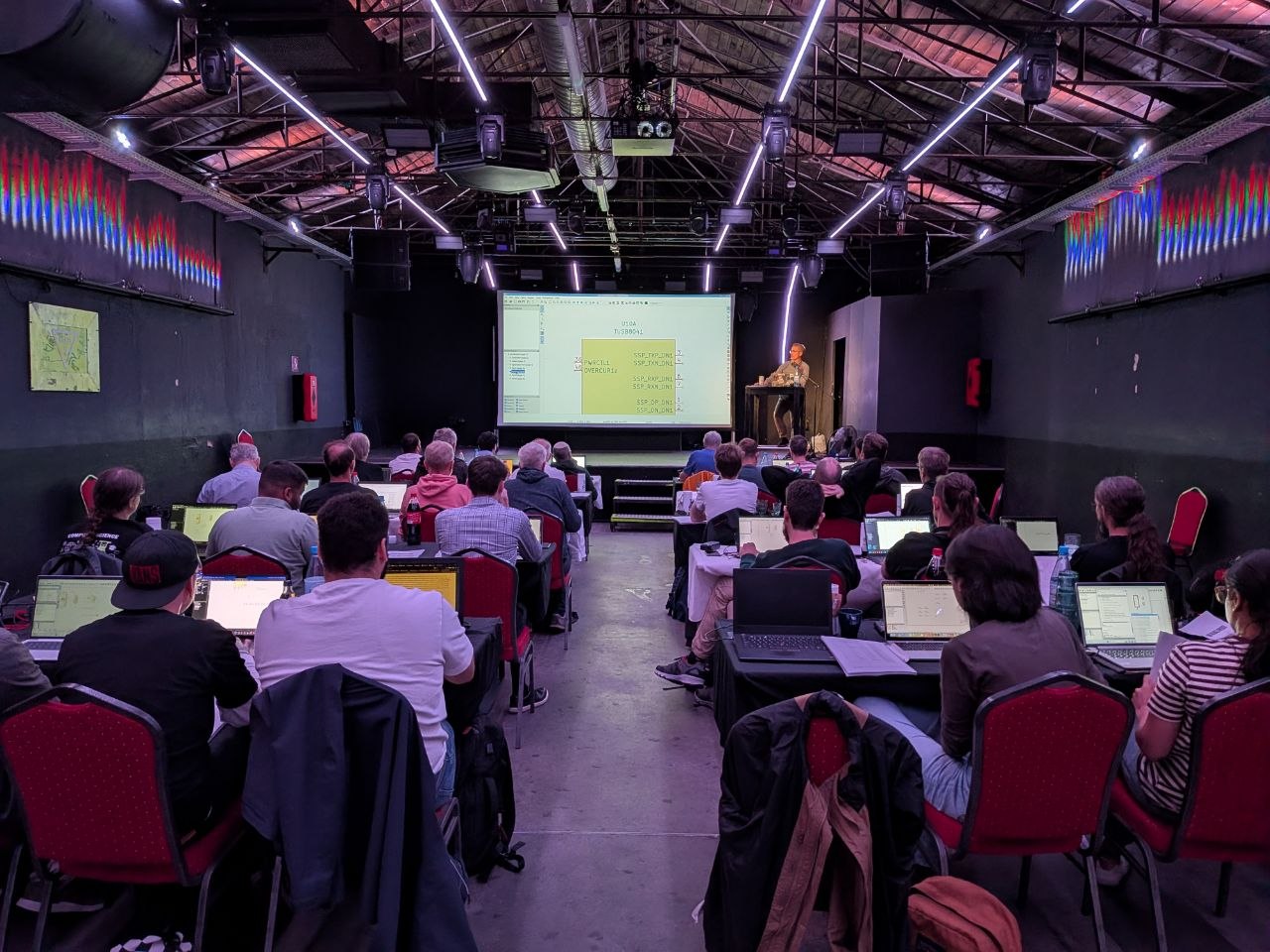

Teardown went surprisingly fast. Sorting everything back into storage is always hell.


What is next
All in all a successful event. Let’s see how we organise 2027. The conference may move to Munich and be hosted by Würth Elektronik, but that will only become clear in the next few weeks. Next goal on my list: prepare a documentation talk for KiCon Asia in Shenzhen, where I spoke about wire bonding last year.
The full programme with abstracts is on pretalx. Recordings will appear on the KiCad YouTube channel as they are cut.